
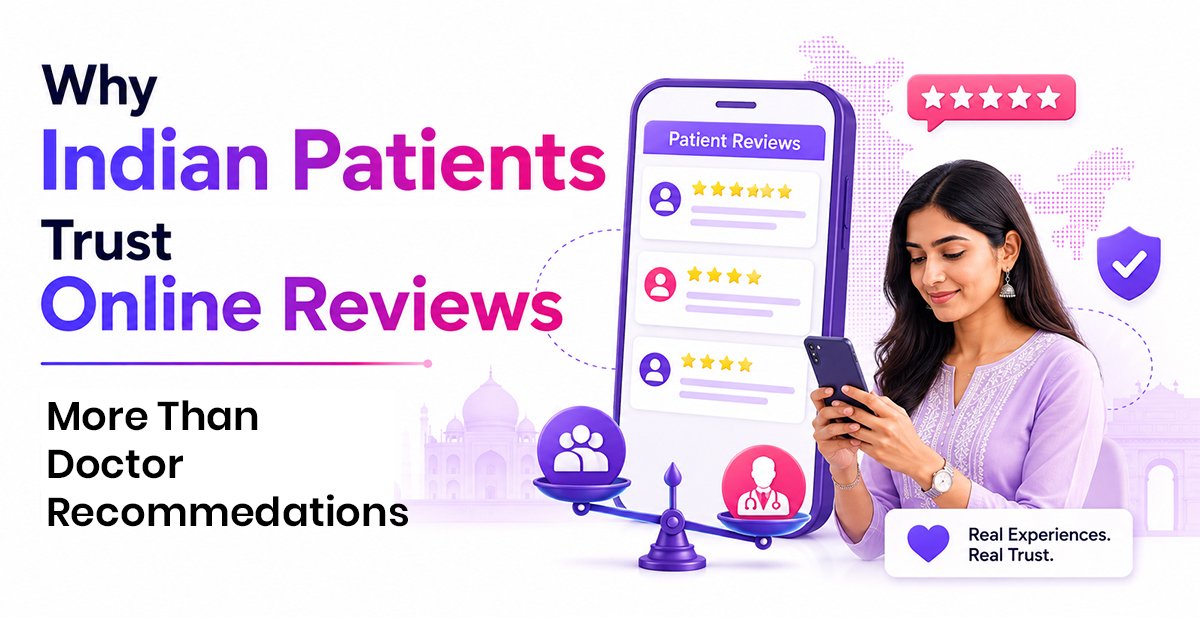
A patient in Ludhiana needs a cardiologist. She doesn’t ask her family doctor. She opens Google, reads 23 reviews, checks the star rating, and books an appointment — all in under 8 minutes.
This is not an exception. This is the new patient journey across Punjab, Delhi, and North India. And if your clinic or hospital isn’t managing patient reviews importance India actively, you’re losing patients to competitors who are — even if your doctors are better.
The trust has shifted. The question is whether your practice has shifted with it.
Why Are Indian Patients Ignoring Doctor Referrals and Trusting Strangers Online?
This isn’t about distrust of doctors. It’s about how people make decisions under uncertainty.
Healthcare is deeply personal and often anxiety-inducing. Before walking into a clinic, patients want reassurance — and a referral from a busy family doctor doesn’t give them that anymore. An online review from someone who experienced the same procedure, the same anxiety, and came out satisfied? That hits differently.
A 2023 survey by LocalCircles found that over 68% of urban Indian patients check online reviews before choosing a specialist — and that number is higher among 25–45 year olds, your most active patient demographic.
What they’re looking for is specific: wait times, doctor behavior, billing transparency, staff attitude. They’re not reading reviews to find a perfect score — they’re reading to spot red flags. If your last five Google reviews are from 2021, that silence tells them something too.
For clinics in Amritsar, Chandigarh, Jalandhar, or anywhere in North India, this behavioral shift has a direct revenue consequence. Patients who can’t find social proof online simply choose someone who has it.
How to Build a Review Strategy That Actually Converts Patients
Most healthcare providers think review management means responding to negative comments. That’s the last 10% of the job.
The first 90% is generating consistent, authentic, keyword-rich reviews on the right platforms — primarily Google Business Profile, but also Practo, Justdial, and increasingly, Facebook recommendations.
Here’s how BubbleWorld approaches this for healthcare clients:
- Audit First. We start with a complete review profile audit — total review count, recency, star distribution, response rate, and competitor benchmarking. Most clinics discover their competitors have 3x more reviews simply because they ask for them.
- Build a Review Collection System. We set up automated post-visit prompts via WhatsApp or SMS that go out within 2 hours of discharge or appointment completion. Response windows matter — a patient is most likely to leave a review within 4 hours of a positive experience. After 24 hours, the impulse drops sharply.
- Train Frontline Staff. Reception and nursing staff are your review generation engine. A simple, non-pushy script — “Sir, if you’re happy with your visit today, it would mean a lot if you shared your experience on Google” — increases review submissions by 40–60% in our testing across North India clinics.
- Respond to Every Review. Every response is indexed by Google. Replying to reviews — positive and negative — signals active management and improves local SEO directly. For negative reviews, a calm, professional response often does more for patient trust than the positive reviews themselves.
- Track and Iterate. Monthly reporting on review velocity, average rating movement, and correlation with new patient inquiries. If reviews aren’t driving appointment volume, something in the funnel needs to change.
What This Looks Like in Practice
Amandeep Hospitals, one of North India’s leading multi-specialty hospital networks, is a BubbleWorld client. When we began working on their digital presence, the challenge wasn’t awareness — it was converting that awareness into patient trust at the decision stage.
By systematically improving their online review presence alongside structured SEO and Meta Ads campaigns, BubbleWorld helped drive measurable improvement across their digital patient acquisition metrics. The broader BubbleWorld portfolio — 156+ projects, 95% client retention — demonstrates that this methodology translates across healthcare contexts, not just individual campaigns.
Separately, Tucan Travel saw 310+ leads per month through BubbleWorld’s integrated approach. While a different sector, the principle is identical: structured digital trust signals convert better than passive online presence. Healthcare works the same way.
In our experience working with 156+ Punjab brands, the clinics that grow fastest aren’t necessarily the ones with the best doctors — they’re the ones where a potential patient can feel confident before they even walk through the door. Reviews are the mechanism that creates that confidence.
4 Things Your Clinic Should Do This Week
- Request a Google Business Profile audit. Check your total review count, your last 10 reviews’ recency, and whether you’ve responded to each one. If you haven’t responded to even one review in the last 30 days, that’s a gap.
- Set up a post-visit WhatsApp message. Keep it short, personal, and direct. Include your Google review link. Send it within 2 hours of the visit. This one step alone can double your monthly review volume.
- Benchmark against your top 3 local competitors. Search your specialty + city on Google. How many reviews do the top 3 results have? What’s their average rating? That gap is your target.
- Create a response template for negative reviews. You will get them. Having a professional, empathetic template ready prevents reactive, defensive replies that damage trust further. Acknowledge, apologize where warranted, and offer a resolution channel offline.
Ready to Turn Patient Reviews Into a Patient Acquisition Engine?
If patients are searching for your specialty in your city and choosing someone else, the gap is almost always in digital trust signals — and patient reviews are the fastest-moving lever available to you. BubbleWorld works with healthcare providers across Punjab and North India to build review strategies that directly impact appointment volume. One conversation is enough to identify exactly where you’re losing patients online.