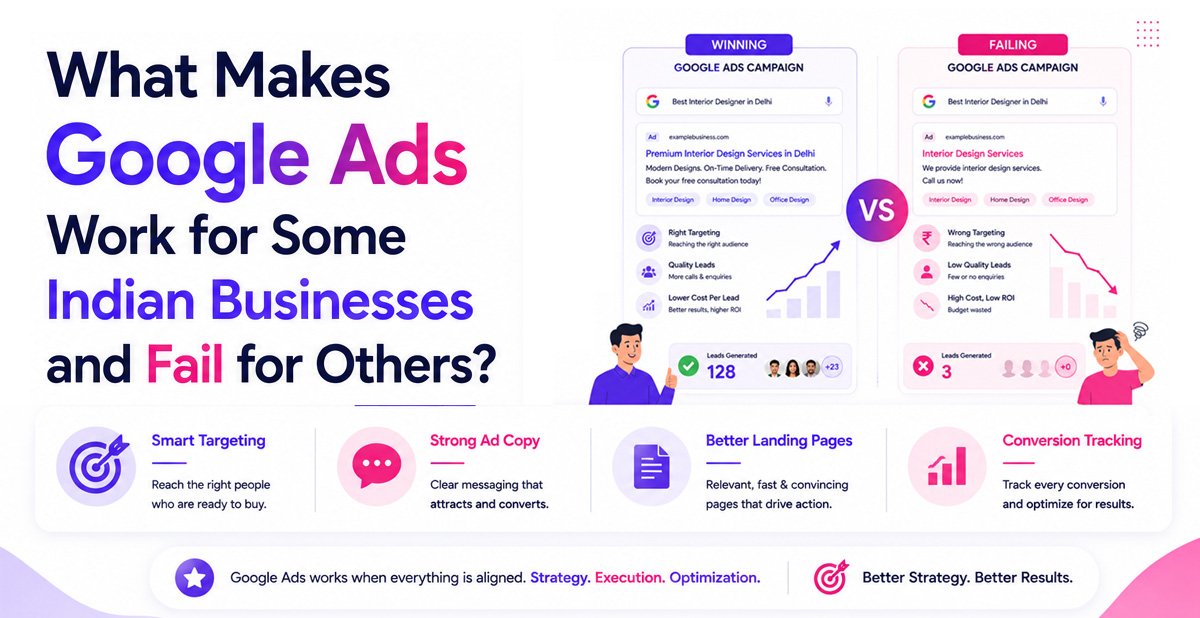
Two businesses. Same city. Same industry. Both running Google Ads.
One is generating a steady pipeline of inbound leads at a cost that makes commercial sense. The other has spent ₹40,000 over two months, fielded a handful of irrelevant enquiries, and is now convinced that Google Ads “doesn’t work in India.”
The platform is identical. The difference is everything that sits around it.
Google Ads is not a lottery. It rewards businesses that approach it with the right strategy, structure, and patience — and it penalises those who treat it like a shortcut. Understanding why it works for some and fails for others is the most valuable thing you can do before investing your marketing budget.
Intent Is the Engine — But Only If You Harness It Correctly
The core advantage of Google Ads over every other digital advertising platform is purchase intent. When someone searches “commercial interior designer in Delhi” or “best CBSE school in Ludhiana,” they’re not browsing — they’re actively looking. That’s a fundamentally different mental state from someone scrolling Instagram between meetings.
But intent only becomes revenue if you meet it with the right keyword strategy.
Here’s where most Indian businesses go wrong from the start: they bid on broad, high-volume keywords without understanding what those searches actually mean.
Bidding on “marketing agency” when you serve Delhi NCR businesses specifically will show your ad to everyone searching that phrase across the country — and beyond. You’ll burn budget on irrelevant clicks from people in cities you don’t serve, at price points you don’t offer, looking for services you don’t provide.
A sharp Google Ads strategy India relies on three keyword disciplines:
- Exact and phrase match keywords to control who sees your ad and why
- Negative keywords — an active, growing list of terms you don’t want to trigger your ad. This single practice can cut wasted spend by 30–40%.
- Long-tail, high-intent keywords — longer, more specific search phrases that signal readiness to buy. “Affordable CA firm for GST filing in Chandigarh” will cost less per click and convert far better than simply “CA firm.”
Intent is only as powerful as your ability to capture the right slice of it.
Your Ad Is a Door — The Landing Page Is the Room
There’s a common misconception among businesses new to Google Ads: the ad does the selling. It doesn’t. The ad earns the click. What happens after the click determines whether that spend becomes a lead or a loss.
In India, this is where a significant percentage of Google Ads budgets quietly disappear.
A business runs a well-written ad promising “Free Digital Marketing Consultation for North India Businesses.” The user clicks, expecting to land somewhere that confirms that offer, gives them a reason to trust the business, and makes it effortlessly easy to book. Instead, they land on a homepage with six navigation options, a slider that takes three seconds to load on mobile, and no mention anywhere of the free consultation.
The user leaves. The money is spent. The lead never existed.
A converting landing page isn’t complicated — but it must be intentional. It repeats the ad’s promise in the headline. It gives one clear action above the fold. It loads in under two seconds on mobile (non-negotiable, given that over 70% of Google searches in India happen on mobile devices). And it removes every possible distraction between the visitor and the conversion.
The best Google Ads strategy in India treats the landing page as a living asset — tested, refined, and rebuilt when the data demands it.
Bidding Strategy and Budget Allocation Are Not Set-and-Forget
Many Indian business owners launch Google Ads campaigns, set a daily budget, choose automated bidding, and check back two weeks later. By then, Google’s algorithm has spent the budget learning — often inefficiently — and results are murky at best.
Automated bidding strategies like Target CPA or Maximise Conversions are powerful, but only after the campaign has enough conversion data to work with. In the early weeks, manual bidding or enhanced CPC gives you more control while the algorithm learns what a valuable click looks like for your business.
Budget allocation also requires strategic thought. Spreading ₹500/day thinly across eight campaigns means none of them gather data fast enough to optimise. Concentrating budget on two or three tightly focused campaigns in the early phase produces cleaner data, faster learning, and better outcomes.
And critically — not all hours and days are equal. A B2B service firm in Gurgaon likely gets its best leads between 9 AM and 6 PM on weekdays. Running ads through the night to a business audience wastes spend on searches that won’t convert. Ad scheduling, reviewed weekly and adjusted monthly, is a lever most Indian businesses never touch.
Quality Score: The Hidden Force Behind Your Cost Per Click
Google doesn’t just reward the highest bidder. It rewards relevance. Quality Score is Google’s internal rating of how well your keyword, ad copy, and landing page work together — and it directly affects both your ad placement and your cost per click.
A business with a Quality Score of 8/10 can outrank a competitor bidding twice as much, at a lower cost. A business with a Quality Score of 3/10 will overpay for every click and be outranked by more relevant competitors regardless of budget.
Improving Quality Score comes down to three things: tight keyword-to-ad relevance (your ad copy must clearly address the keyword that triggered it), compelling ad copy that earns high click-through rates, and a landing page that delivers on every promise the ad makes.
Most Indian businesses treat these three as independent variables. High-performing campaigns treat them as one connected system.
Measurement Gaps Kill Campaigns Before They Have a Chance
This is perhaps the most underappreciated reason Google Ads fails for Indian businesses: the measurement is broken before the campaign even launches.
If conversion tracking isn’t set up correctly — if form submissions, phone calls, and WhatsApp clicks aren’t being recorded as conversions inside Google Ads — the algorithm is flying blind. It cannot optimise for outcomes it cannot see. You end up with impression data, click data, and spend data, but no reliable signal of what’s actually working.
Before spending a single rupee, verify that:
- Google Ads conversion tags are firing correctly on every thank-you page and form submission
- Call tracking is in place if phone enquiries are a primary lead source
- Google Analytics and Google Ads are linked, and goals are mapped
Data integrity isn’t a technical afterthought. It’s the foundation every good Google Ads strategy India is built on.
The Pattern Behind Every Failing Campaign
After reviewing dozens of Google Ads accounts across Indian businesses — from manufacturers in Punjab to education brands in Delhi NCR — the same pattern emerges in the ones that drain the budget without results.
Wrong keywords targeting the wrong intent. A landing page that doesn’t convert. A bidding strategy applied before the data exists to support it. A Quality Score depressed by misaligned messaging. And measurement gaps that leave the algorithm guessing.
None of these are unfixable. All of them are preventable.
Google Ads is not a gamble. For Indian businesses in competitive markets — real estate, education, healthcare, professional services, manufacturing — it remains one of the most powerful, scalable, and measurable lead generation channels available. But it responds to discipline, not hope.
Get the fundamentals right, and the ROI follows.
Want an honest audit of your Google Ads account to find exactly where the budget is leaking? Then visit BubbleWorld today and we’ll show you what the data says.