Every rupee in your marketing budget needs to earn its keep. And when it comes to digital marketing, most Indian business owners eventually face the same question: should I put my money into Google Ads — or invest in SEO?
The honest answer? It depends. But that’s not a cop-out. The right answer can save you lakhs of rupees and years of frustration. In this guide, we break down Google Ads vs SEO India — how each works, what each costs, and which one genuinely delivers better ROI for your specific situation.
What Are We Actually Comparing?
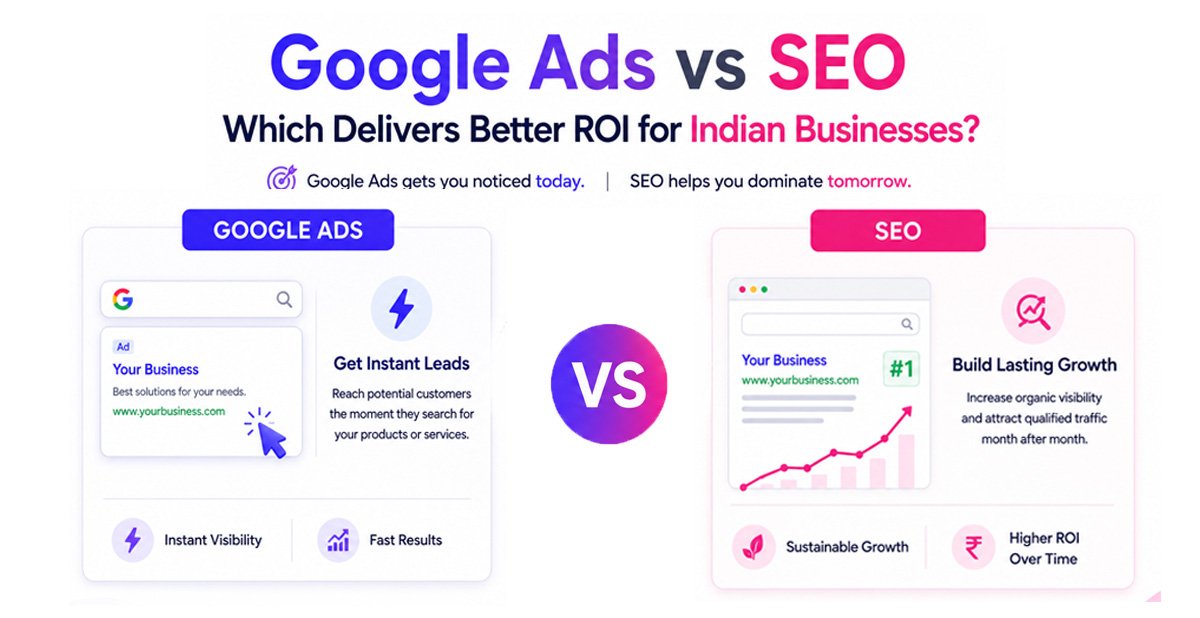
Google Ads (formerly Google AdWords) is a paid advertising platform where you bid to appear at the top of search results. You pay every time someone clicks your ad — this is called Pay-Per-Click (PPC). Stop paying, and your visibility disappears immediately.
SEO (Search Engine Optimisation) is the process of optimising your website so it ranks organically (unpaid) on Google. It takes time to build, but once you rank, traffic flows to you without paying per click.
Both strategies put your business in front of people searching on Google. The difference lies in speed, cost, and sustainability.
The Case for Google Ads
If your business needs results now, Google Ads is hard to beat. The moment your campaign goes live, your ad can appear on the first page of Google — even if your website was built last week.
Where Google Ads wins for Indian businesses:
- New product or service launches — You can’t wait 6 months for SEO to kick in when you’re launching a new offering.
- Seasonal businesses — Think wedding planners in Ludhiana, CA firms during tax season, or travel agencies before summer holidays. Google Ads lets you switch spend on and off with precision.
- High-competition local markets — If you’re a real estate developer in Gurugram or a hospital in Amritsar competing with established players, paid ads give you an immediate seat at the table.
- Testable, data-rich campaigns — Within days, you know exactly which keywords convert. This is powerful intelligence you can later use for your SEO strategy too.
The catch: CPC (cost-per-click) rates in India have been rising steadily. Competitive sectors like insurance, real estate, education, and healthcare can see CPCs anywhere from ₹50 to ₹500+. Without expert campaign management, ad spend can bleed fast — with little to show for it.
The Case for SEO
SEO is a slower game, but the payoff is compounding. Unlike paid ads, organic traffic doesn’t stop the moment you pause your budget.
Where SEO wins for Indian businesses:
- Long-term cost efficiency — Once your pages rank, you receive traffic for free. A well-optimised blog post or service page can drive leads for years without recurring spend.
- Trust and credibility — Indian consumers, like most people, trust organic results more than paid ads. Ranking on page one signals authority in your field.
- Local SEO dominance — For businesses serving specific cities or regions — say, a clinic in Jalandhar or a CA firm in Chandigarh — local SEO can bring in highly qualified leads at near-zero cost over time.
- Compounding returns — The more quality content and backlinks you build, the stronger your domain becomes. Your 50th blog post benefits from the authority built by the previous 49.
The catch: SEO is a 6–12 month investment before meaningful results appear. If your business is struggling with cash flow or needs immediate leads, waiting for organic rankings isn’t practical. SEO also requires ongoing effort — Google’s algorithm updates constantly, and competitors don’t stand still.
ROI Comparison: The Numbers Behind the Decision
Let’s look at this practically. Assume you have a monthly digital marketing budget of ₹50,000.
Factor | Google Ads | SEO |
Time to first results | Days | 4–12 months |
Cost structure | Pay per click | Agency/content fees |
Traffic after stopping | Drops to zero | Continues (gradually) |
Average monthly leads (Month 1) | High | Low to none |
Average monthly leads (Month 12) | Consistent (if budget continues) | Growing |
Long-term cost per lead | Higher | Lower |
Brand trust signal | Moderate | High |
In most Indian business contexts, SEO delivers better ROI over a 12–24 month horizon, while Google Ads wins for immediate returns within a 1–3 month window.
So Which Should You Choose?
Here’s a practical framework for Indian business owners:
Choose Google Ads if:
- You’re a new business that needs leads immediately
- You’re running a limited-time offer or promotion
- You operate in a seasonal industry
- You want to test which services/products have demand before investing in SEO
- Your average order or deal value is high enough to absorb the cost per lead
Choose SEO if:
- You’re thinking 12+ months ahead
- You want to reduce dependence on ad spend
- You operate a content-driven business (education, healthcare, finance, coaching)
- You want to build long-term brand authority in your niche
- You’ve already validated your offerings and know what your audience searches for
The smartest move? Use both — strategically.
Many successful Indian businesses run Google Ads to generate immediate revenue while simultaneously investing in SEO for long-term growth. As SEO begins to deliver organic leads, you can gradually reduce your ad spend — lowering your cost per acquisition over time.
A Word on Budget Allocation
For businesses with a budget of ₹30,000–₹1,00,000/month, a common split is:
- 60% Google Ads / 40% SEO in the first 6 months (while SEO builds momentum)
- 40% Google Ads / 60% SEO from month 7 onwards
- 20% Google Ads / 80% SEO once organic rankings are delivering consistent traffic
This approach protects revenue in the short term while building an asset — your organic search presence — that pays dividends for years.
Final Verdict
There’s no universal winner in the Google Ads vs SEO India debate. But here’s what’s true across every industry and city in India: businesses that treat SEO and Google Ads as complementary tools — not rivals — consistently outperform those that rely on just one.
If you’re planning your marketing budget and aren’t sure where to start, begin by answering one question: How soon do I need results? Let that answer guide your initial allocation — and let data guide every decision after that.
Ready to build a digital marketing strategy that balances speed and sustainability? Then consult with BubbleWorld today. We will share you the customised plan for your business.