Every founder has seen it happen. A competitor posts a reel that blows up — 2 million views, thousands of shares, the algorithm gods smiling down for exactly 72 hours. Everyone in the office is talking about it. “We need to do something like that.”
So the team scrambles. They chase the format, chase the trend, chase the feeling of that spike. Sometimes they get a decent post out of it. Occasionally, one lands well. But three months later, the business looks exactly the same. No compounding growth. No inbound leads. No brand authority that outlasts the next trending audio.
This is the trap that kills content marketing strategy India for hundreds of growing brands every year — optimising for the moment instead of the movement.
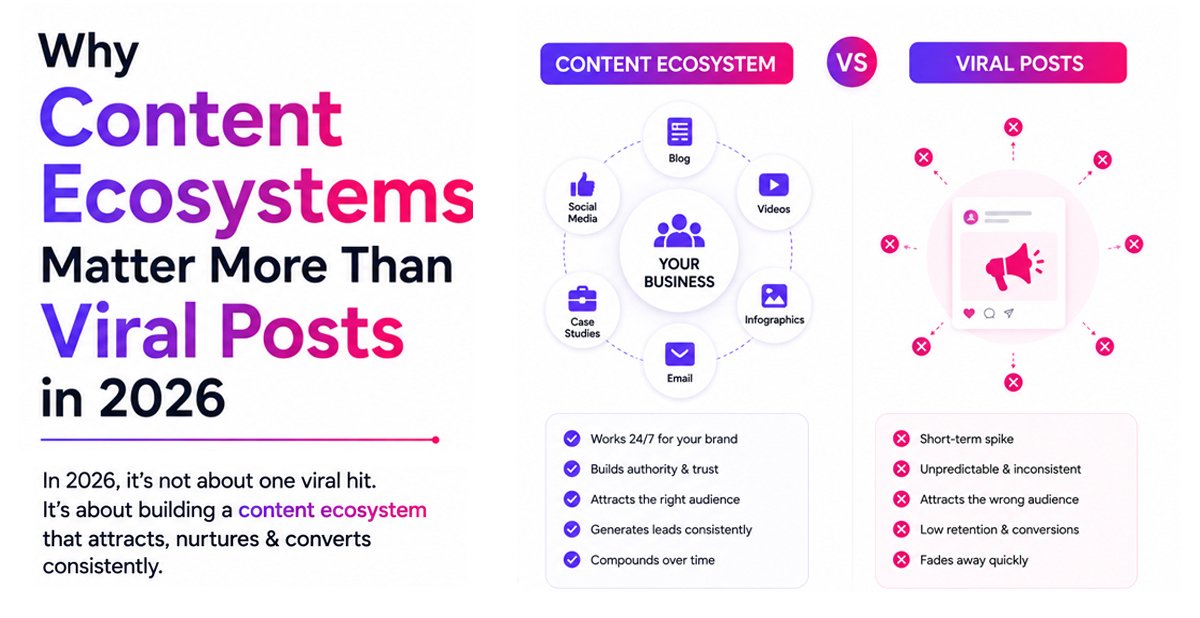
In 2026, the brands winning with content aren’t the ones who go viral. They’re the ones who’ve built ecosystems.
What a Viral Post Actually Does (And Doesn’t Do)
Let’s give viral content its due. Reach is real. Attention is currency. A post that travels far can introduce your brand to audiences you’d never have paid to reach.
But here’s what a viral post cannot do on its own: it cannot build trust, establish expertise, nurture a buyer who isn’t ready today, or create the kind of consistent brand recall that makes someone think of you first when they finally need what you offer.
A viral post is a spike. A content ecosystem is a slope — a steady, compounding incline where every piece of content adds to the body of work, every platform reinforces another, and every new visitor lands in a world that answers their questions and earns their confidence over time.
The difference between a brand that grew and a brand that just got attention is almost always this: one was building an ecosystem while the other was chasing spikes.
What a Content Ecosystem Actually Is
An ecosystem isn’t complicated, but it is intentional. At its core, it’s a connected web of content across formats and platforms, all serving a defined audience at different stages of their journey.
Think of it this way. A founder-led B2B brand in India might run like this: long-form LinkedIn articles that establish deep expertise attract decision-makers early in their research. Short-form reels or carousels on Instagram and YouTube Shorts introduce the brand to new audiences. A weekly newsletter deepens the relationship with people already following. A blog optimised for search captures people actively looking for answers on Google. Case studies and testimonials convert the interested into the convinced.
None of these works as well alone. Together, they create something powerful — a prospect can discover you through a YouTube Short, follow you on LinkedIn, receive your newsletter for six weeks, find your website when they search for a solution, and call you ready to buy. You didn’t chase them. The ecosystem pulled them through.
That’s what a mature content marketing strategy India actually looks like in 2026.
Why This Matters More Than Ever in India Right Now
The Indian digital landscape has changed fundamentally in the last three years. Content consumption is enormous — India has among the highest video consumption rates globally, and short-form content has exploded across demographics, languages, and geographies.
But here’s the side effect: everyone is creating content. Every founder is on LinkedIn. Every brand is doing reels. Every category is noisier than it was eighteen months ago. In a crowded room, the loudest voice doesn’t win — the most trusted one does.
Indian buyers, whether B2B or B2C, are also more research-driven than ever before. The purchase journey is longer and involves more touchpoints. A patient shortlisting hospitals reads blogs, watches doctor videos, checks Google reviews, and asks on WhatsApp groups before booking. A procurement head evaluating a vendor reads LinkedIn posts, checks the company website, looks for industry recognition, and sometimes reads the founder’s newsletter.
If your content strategy is only “post reels and hope one goes viral,” you’re absent for most of this journey. A content ecosystem ensures you’re present — and credible — at every stage.
The Three Layers Every Content Ecosystem Needs
Layer One: Discovery Content This is how new audiences find you. Reels, Shorts, trending topic posts, SEO-optimised blogs, podcast appearances, collaborations. The job here is reach — introducing your brand to people who don’t know you exist. This is the layer most brands focus on exclusively, which is the mistake.
Layer Two: Depth Content This is where trust is built. Long-form articles, detailed explainers, case studies, email newsletters, YouTube videos that go beyond 60 seconds, webinars. This content doesn’t go viral. It doesn’t need to. Its job is to answer the deeper questions of someone who found you and wants to know more. It’s the difference between a first impression and a lasting one.
Layer Three: Conversion Content This is the content that makes someone act — testimonials, before-and-after results, detailed service pages, founder Q&As that address objections, comparison content, free tools or resources that demonstrate your competence. This layer is almost entirely ignored by brands focused on social media performance.
Most Indian brands have too much of Layer One and almost none of Layers Two and Three. The ecosystem approach demands all three working together.
Where Most Brands Go Wrong
The most common failure in content marketing strategy India is treating each platform as a separate strategy rather than a connected system. Instagram is handled by the social media executive. The blog is written occasionally when someone has time. The newsletter was started, paused, and quietly abandoned. LinkedIn is the founder’s personal playground with no connection to company goals.
The result is content that creates no compounding effect. Every month, you start from zero again.
An ecosystem approach means every platform has a role, every piece of content points somewhere, and every new follower enters a journey — not just a feed.
The Shift That Changes Everything
The mental shift required is from content as performance to content as infrastructure.
Performance thinking asks: did this post do well? Infrastructure thinking asks: does this body of work make us the obvious choice in our category?
A viral post is a day. A content ecosystem is a decade. The brands that will dominate their categories in India by 2028 are building their ecosystems right now — quietly, consistently, without waiting for the algorithm to reward them.
The question isn’t whether you should chase the next viral moment. The question is whether, when someone finally discovers your brand, there’s a world waiting for them — or just a feed.
Your content marketing strategy should outlast any single post. Start by mapping where your audience is in their journey and what content you have — or don’t have — waiting for them at each stage. You can also just reach out to BubbleWorld and we can help you in strategising your content.