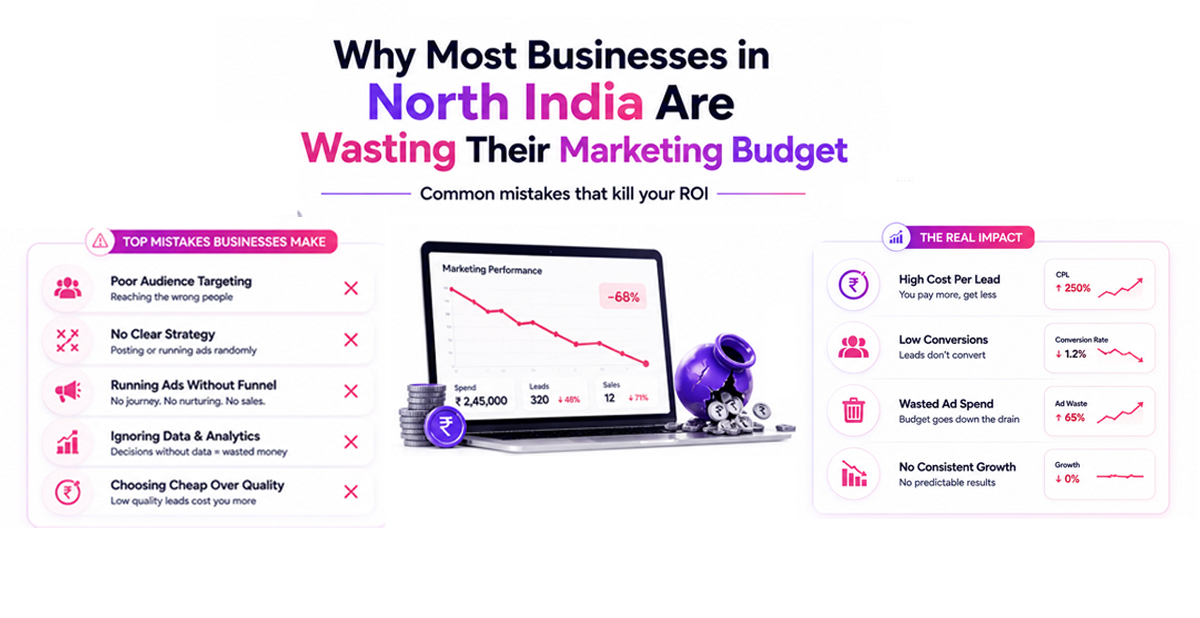
You’ve spent ₹50,000. Maybe ₹80,000. The agency sends you a PDF with impressions and reach numbers. Your phone hasn’t rung once. This is not bad luck — it’s a systemic problem with how digital marketing ROI India is being sold versus delivered. Most agencies in North India are optimizing for invoices, not outcomes. And most business owners don’t realize it until they’ve paid for six months of nothing.
Why Is Your Digital Marketing Budget Disappearing Without Results?
The problem isn’t that digital marketing doesn’t work. It works — verifiably, measurably, repeatedly.
The problem is how most agencies in this market operate. They sell packages, not strategies. They run ads without tracking conversions. They report on vanity metrics — likes, reach, impressions — while your actual business sits flat.
Here’s what a broken engagement typically looks like:
You hire an agency. They set up a Meta Ads campaign. They post 12 times on Instagram. They send you a monthly report showing 1.4 lakh “people reached.” But there’s no UTM tracking on your links. No conversion pixel on your website. No call tracking on your number. So when someone asks you, “how many leads did that ₹80,000 generate?” — you genuinely don’t know.
That’s not a reporting gap. That’s a strategy gap.
This is the pattern we see repeatedly from businesses coming to us after bad agency experiences — across Amritsar, Ludhiana, Chandigarh, Delhi. The businesses weren’t careless. They were trusting the wrong framework.
The digital marketing agency North India market is full of vendors who can run an ad. Very few can engineer a return on it.
How to Actually Make Your Marketing Budget Work in India?
Fixing your marketing budget India problem starts with one principle: every rupee spent must connect to a trackable outcome. Not a feeling. Not a dashboard full of reach numbers. A lead, a sale, a booked appointment, a filled form.
At BubbleWorld, we build what we call a Revenue-Linked Marketing System. It has four components:
- Conversion Infrastructure First
Before one rupee goes into ads, we audit your website’s ability to convert visitors. Is there a clear CTA above the fold? Does the contact form work on mobile? Is there a pixel firing on form submissions? Most clients come to us with websites that leak traffic like a broken pipe.
- Funnel-Matched Campaigns
Different platforms serve different stages of the buyer journey. Google Search captures intent — people already looking for what you offer. Meta Ads builds awareness and retargets warm audiences. We don’t run both the same way, because they aren’t the same thing. A dentist in Amritsar doesn’t need reach in Bengaluru. They need 47 booked appointments in their PIN code.
- Keyword Strategy That Earns, Not Just Ranks
SEO isn’t about getting to page one for a keyword nobody searches. We map keywords to buyer intent. “Dental clinic Amritsar” is worth infinitely more than “best oral care tips.” Our clients have 56 ranked keywords across categories — all mapped to commercial intent.
- Reporting That Shows Business Outcomes
We report on leads generated, cost per lead, and conversion rates — not followers gained. When a client asks us for their ROI, we give them a number.
This is how you stop wasting ad spend and start seeing compounding returns.
What This Looks Like in Practice
A business came to us having spent ₹80,000 over three months with a previous agency. The deliverables looked fine on paper — posts went up, ads ran, a monthly report arrived. But there was zero conversion tracking set up. No call tracking. The website had no pixel. The “leads” column in their records was blank.
We started from infrastructure. Pixel installed. Call tracking enabled. Landing page rebuilt for mobile. Google Ads restructured around high-intent local search terms. Meta Ads audience narrowed to a 25 km radius with demographic filters matching their actual buyer profile.
Month one: 34 trackable leads. Month two: 61. Month three: 89.
Same budget. Completely different architecture.
Raghav Aneja, who leads BubbleWorld, puts it plainly: “In our experience working with 156+ Punjab brands, the number one reason businesses don’t see digital marketing ROI India is not their budget — it’s that nobody built the system to catch what the budget was generating.”
This isn’t about spending more. It’s about spending with a connected system behind it.
For Tucan Travel, that system now delivers 310+ leads per month. For Amandeep Hospitals, it means consistent local visibility across Amritsar. The principle is identical regardless of industry — infrastructure before spend.
4 Things You Should Do Before Spending Another Rupee on Marketing
You don’t need to blow up your current setup. You need to diagnose it honestly.
- Audit your conversion tracking. Go to your website right now and submit your own contact form. Did you receive it? Did it fire a confirmation? If you’re running Meta Ads, is there a pixel on that thank-you page? If the answer to any of these is no, you have a leak.
- Demand outcome reports, not activity reports. Your agency should be reporting leads, cost per lead, and return on ad spend — not just reach and impressions. If their monthly report has no lead count, ask for one. If they can’t provide it, that tells you everything.
- Narrow your targeting before you scale your budget. Most small and mid-size businesses in North India are over-broadcasting and under-targeting. A ₹20,000 campaign in a 15 km radius with strong intent targeting will outperform a ₹60,000 campaign aimed at all of India.
- Check whether SEO and paid are talking to each other. Your top organic keywords should inform your paid bidding strategy, and vice versa. If your SEO agency and your ads agency have never spoken, you’re running two disconnected engines.
Ready to See What Your Budget Should Actually Be Returning?
Book a free growth audit today.
If you’ve spent money on digital marketing and can’t point to a lead number, it’s not your fault — but it is your problem to fix. We’ll audit your current setup, show you exactly where the gaps are, and tell you what a realistic return looks like. No pitch deck. No vague promises. Just the numbers.