You’re spending ₹2–5 lakhs a month on ads. The agency sends you a PDF full of impressions, reach, and “brand awareness.” But your sales team’s phones aren’t ringing. That gap — between ad spend and actual revenue — is exactly what a performance marketing agency India is built to close.
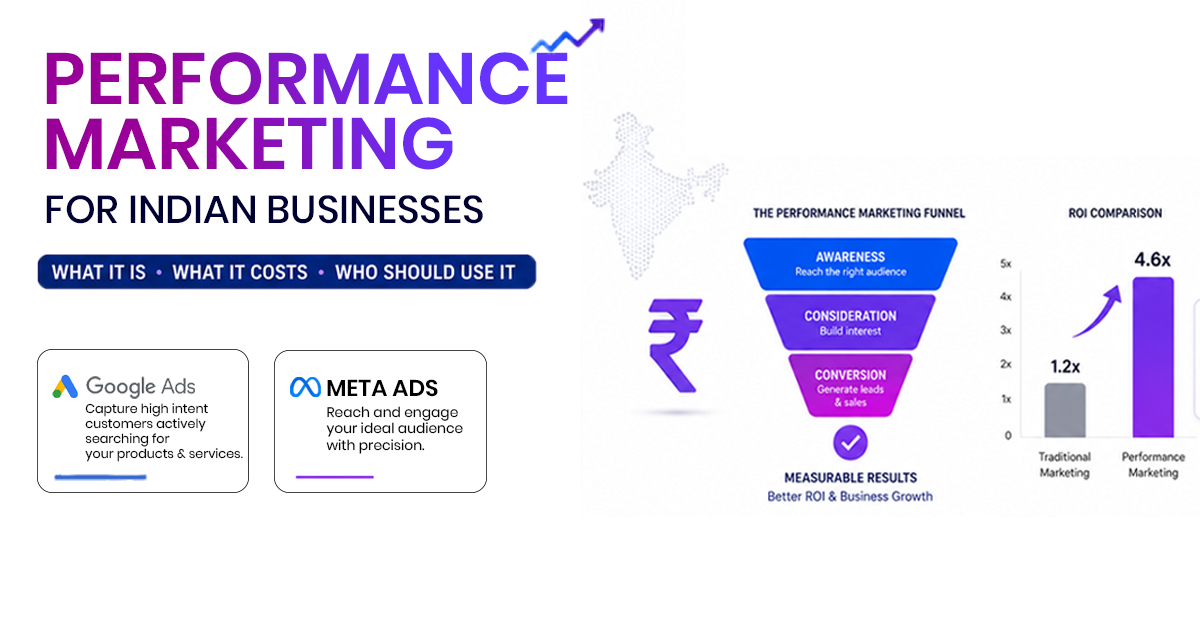
This isn’t a brand exercise. Performance marketing is the discipline of spending money on ads only when something measurable happens: a lead, a sale, a booking, a sign-up. Every rupee is tracked. Every campaign is judged by outcomes, not aesthetics.
If you’re a Delhi or North India business owner with a serious ad budget and tired of paying for vanity metrics, read this carefully.
Why Most Indian Businesses Are Paying for Ads That Don’t Convert
Here’s what typically happens. A business owner signs up with a digital agency. The first month brings polished creatives and a detailed onboarding deck. Month two brings a report showing 4 lakh impressions and a 2.3% engagement rate. Month three, you ask where the leads are. The agency says “the algorithm is warming up.”
You’ve been sold reach when you needed revenue.
This isn’t just a bad agency problem — it’s a structural misunderstanding of what digital advertising is supposed to do. Most agencies in India are still selling outputs: posts published, ads run, clicks generated. Performance marketing flips this. It’s built entirely around inputs that tie directly to business outcomes.
The reason so few agencies in India operate this way is simple: accountability is hard. When you’re measured by leads and revenue, there’s nowhere to hide. Agencies that can’t deliver avoid the model entirely.
How Performance Marketing Actually Works — and Why the Methodology Matters
A true performance marketing setup has four non-negotiable layers.
Tracking infrastructure first. Before a single rupee goes into ads, every conversion point on your website — form submissions, calls, WhatsApp taps, purchase confirmations — must be firing correctly. Without this, you’re flying blind regardless of how good your creative is.
Audience architecture second. For Meta Ads, this means building layered audiences: cold traffic from interest and lookalike targeting, warm retargeting pools from website visitors and video viewers, and hot audiences from existing customer lists. For Google Ads, this means separating intent-based search campaigns from display and Performance Max, and bidding differently on each.
Creative as a performance variable, not decoration. In performance marketing, your ad creative is a hypothesis. You run three to five variations simultaneously, let the data tell you which one drives the lowest cost-per-lead, kill the rest, and iterate. Most businesses treat creative as a branding decision. Performance marketers treat it as a science experiment.
Weekly optimization cycles, not monthly reviews. Ad algorithms reward accounts that signal quality consistently. Waiting 30 days to review performance means you’ve wasted three to four weeks of budget on a failing direction. The best-run performance accounts are reviewed and adjusted at least twice a week.
This is the framework BubbleWorld applies across every Meta Ads and Google Ads engagement — and it’s what separates a lead generation agency India that produces results from one that produces reports.
What This Looks Like in Practice: Investza and Tucan Travel
Two campaigns. Two completely different industries. One consistent approach.
Investza came to BubbleWorld with a clear problem: high-intent investors in Mumbai were hard to reach through conventional targeting, and their cost-per-lead from previous campaigns was unpredictable. We rebuilt their Meta Ads architecture from scratch — tightened the audience segmentation, rewrote the ad copy around specific investment outcomes rather than generic financial messaging, and set up conversion tracking that distinguished between a casual enquiry and a serious investor lead. The result was a consistent, measurable pipeline with ROI that Investza’s team could tie directly to closed business.
Tucan Travel is now generating 310+ qualified leads every single month through a combination of Meta Ads and Google Ads. The key wasn’t spending more — it was spending smarter. We identified the specific search terms and audience segments that were converting to actual bookings versus people just browsing, and reallocated budget aggressively toward what worked. Their campaigns now run at a cost-per-lead that makes their unit economics work comfortably.
“In our experience working with 156+ Punjab and North India brands,” says Raghav Aneja, “the single biggest unlock is almost always tracking. Businesses that think they have a targeting problem almost always have a measurement problem. Fix what you’re measuring, and the right decisions become obvious.”
The cost question comes up in every conversation. Performance marketing cost India varies widely — from ₹30,000/month for a focused single-channel setup to ₹3–5 lakhs/month for full-funnel, multi-platform campaigns with dedicated creative production. What doesn’t vary is the logic: if the cost-per-lead from a campaign is lower than what that lead is worth to your business, you scale. If it isn’t, you fix it before you scale.
What You Should Do Before Spending Another Rupee on Ads
Before you sign another agency retainer or increase your ad budget, run through this list.
- Audit your tracking. Open Google Tag Manager or your Meta Events Manager and verify that every conversion event on your website is firing accurately. If you don’t know how to do this, make it the first thing you ask a prospective agency to demonstrate.
- Define your acceptable cost-per-lead. Calculate what a closed customer is worth to your business over 12 months, then work backwards. If a customer is worth ₹1.5 lakhs in gross margin, a ₹3,000 cost-per-lead with a 10% close rate is a profitable setup. Know this number before any campaign goes live.
- Demand weekly reporting with three numbers. Cost per lead. Lead volume. Lead quality score (what percentage of leads are actually converting downstream). Any agency that can’t give you these three numbers weekly is not running a performance marketing operation.
- Separate your brand budget from your performance budget. Brand awareness and performance conversion are different objectives requiring different campaign structures, creative approaches, and success metrics. Mixing them is one of the fastest ways to get misleading data.
- Review the creative every two weeks. If your top-performing ad hasn’t been refreshed in 45 days, audience fatigue is silently killing your conversion rate.
Ready to See What Your Ad Budget Should Actually Be Producing?
Book a free growth audit today. If you’re running ads and not getting the leads your budget should be generating, the problem is diagnosable — and usually fixable within the first 30 days. BubbleWorld’s team will audit your current campaigns, identify exactly where budget is leaking, and show you a clear path to measurable ROI. No pitch deck. No fluff. Just numbers.
We work with serious businesses across Delhi, Punjab, and North India who want a performance marketing agency India that’s accountable to outcomes, not impressions.