Last quarter’s report is open on your screen. Impressions: up. Reach: up. One reel hit 80,000 views, and the agency has highlighted it in green. You scroll to the bottom looking for the line that says how many people actually bought something, and there isn’t one.
Most founders we talk to have lived some version of this. The work isn’t bad. The numbers aren’t fake. They just don’t answer the question you’re really asking, which is whether any of this is helping the business grow.
It matters more now than it used to. Gartner’s 2026 figures have marketing spend sitting at roughly 7.8% of company revenue, and it hasn’t moved. Nobody is getting a bigger pot to play with. If the budget isn’t growing, the work has to get sharper, and “we posted consistently” stops being a good enough answer.
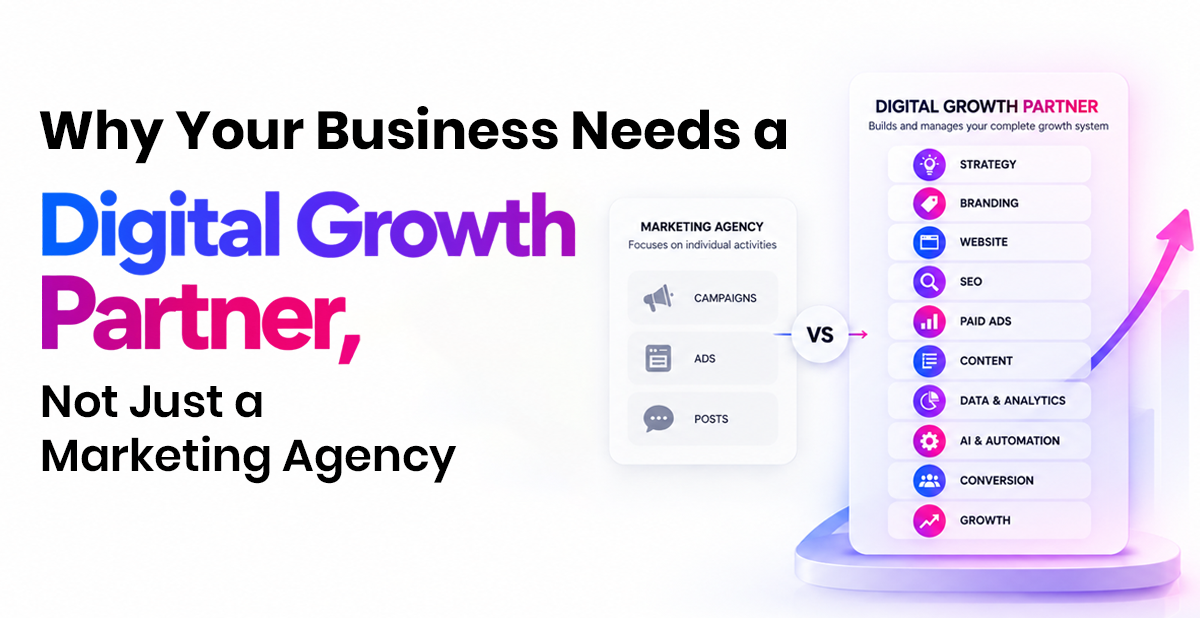
That’s the idea behind a digital growth partner. It’s a different deal from the usual agency arrangement: the people running your marketing carry some of the worry about your revenue, and they plan brand, content, and ads as one thing instead of three. In this post we’ll cover what that looks like day to day, how to tell if you need one, and what to ask before you sign with anyone, including if you’re shopping for a digital marketing agency in Amritsar right now.
So what is a digital growth partner, really?
Strip away the branding and it comes down to who owns the outcome.
With a regular agency, you hand over a brief. Four reels a month, a new landing page, a Google Ads campaign. They make it, you approve it, everyone moves on. If what you need is a clearly defined piece of work, that arrangement is fine, and often cheaper than anything fancier.
It gets awkward when what you want is bigger than a task. Say, “we need to double enquiries before wedding season.” Nobody has actually been asked to be responsible for that. The agency did what the brief said. You still didn’t get the result. Both of you are technically right, which is the most frustrating place to be.
A growth partner flips the order. They start from the goal, work out what has to happen, and only then decide which reels, pages, and campaigns are worth making. The deliverables are still there. They’re just the means now.
Plenty of good agencies already work this way and never use the phrase. So don’t hire a label. Hire the behavior.
How you know you’ve outgrown the usual setup
There’s no official test, but a few things come up again and again.
Your reports are all activity. Posts published, followers gained, clicks. Nice to see, but none of it is a customer.
You can’t say where customers actually come from. Don’t feel bad, almost nobody can. Forrester found that 64% of B2B marketing leaders don’t trust their own marketing measurement. If you can’t trust the scoreboard, deciding where the next ten thousand rupees goes turns into a coin flip with extra steps.
You’re the one with all the ideas. You write the briefs, chase the follow-ups, and remind the agency about the festive offer. At that point you’re paying for hands and doing the thinking yourself.
Your brand work and your ads live in different universes. The reels look gorgeous and nobody buys. Or the ads work for two weeks and then die, because there’s nothing memorable behind them. Each one is feeding the other whether anyone planned it or not.
And somewhere along the way you became the project manager. A designer here, a freelancer there, an ads person, a video editor. Somebody has to hold it together, and it’s you, on a Sunday night.
If two or three of those sound familiar, keep reading.
What changes when someone actually owns the number
A few things, and they show up quickly.
They ask about your business before they ask about your Instagram. Margins, how long people take to decide, how often customers come back, what a customer is worth over a year. A tactic that’s brilliant for a business with a two-day sales cycle can quietly burn money in one with a three-month cycle, and you can’t tell which you are without asking.
The scoreboard is shared. The CMO Survey says B2B product companies outsource around 28% of their digital marketing and services firms about 25%, and both are expected to climb. So outsourcing isn’t really the question anymore. The question is whether you’ve agreed on what “working” means. Digital Applied’s 2026 roundup found that teams with a documented strategy get roughly 3x more leads per dollar, yet only about 42% of teams can prove their return at all. Writing the plan down and choosing the numbers up front sounds dull. It’s most of the battle.
Creative and performance sit together. We care a lot about this one. A cinematic brand film and a lead-generation campaign aren’t competing for budget. The film makes people stop and trust you, and the campaign catches the demand that creates. When one team plans both, an AI storytelling reel or a proper DVC-grade shoot gets built with the conversion path in mind from day one, instead of stapled on afterwards.
And somebody is willing to say “this isn’t working.” Maybe the channel is wrong. Maybe the offer is the problem. Maybe you should wait a quarter. Those conversations are a bit uncomfortable, and they save a lot of money.
What the first 90 days usually look like
Every engagement is different, but there’s a rhythm to it.
Month one is mostly listening. Going through the website, the ad accounts, the analytics, the reviews. Talking to your sales team and, ideally, a few customers. Agreeing on the goal and what the scoreboard will look like.
Month two is where things get built and tried. Positioning gets sharper. Tracking gets fixed (it’s almost always broken somewhere). The first campaigns go out with a clear guess about why they should work. Some will. Some won’t, and that’s the whole point of testing.
By month three there’s enough evidence to decide things. Back what’s working, drop what isn’t, and plan the next quarter on data instead of hunches.
One small warning: most channels need a few months before the pattern can be trusted. Anyone promising a transformation in three weeks is selling you something. Someone who tells you what to expect, and when, is usually worth hearing out.
Picking a digital marketing agency in Amritsar
Think about how someone in Amritsar finds a dentist, a boutique, a restaurant near the Golden Temple, or a hospital for a relative. Most of the time they check Google Maps, flick through the Instagram page, read a few reviews, and send a WhatsApp message before they ever call. Your digital presence has usually done its job, or failed at it, before you know that person exists.
So local knowledge is useful. Knowing how people in your market search, which language they respond to (plenty of Punjabi and Hindi, not only English), and how they prefer to enquire is not a small thing. But an office in the same city isn’t a strategy. Whoever you’re talking to, we’d ask:
- Who will actually be working on my account, week to week?
- How will we know by month three whether it’s working?
- Can you show me a plan for my business, not a portfolio of other people’s?
- What do you do when something underperforms?
- Will one team handle strategy, creative, and ads, or will I be the glue between three vendors?
Listen to how they answer, not only what they say. Vague answers early tend to stay vague.
And to be fair in the other direction, a growth partner isn’t for everyone. If you need a logo, a one-time campaign, or a clearly defined project, a project-based agency will be simpler and cheaper. Growth marketing services make sense when growth itself is the job and you want someone on the hook for it.
Industry Insights
Industry Shift. For a long time marketing was judged by how much got done. More posts, more campaigns, more channels. That’s turning around. With budgets flat and trust in measurement low, founders want the people they hire to share some of the risk instead of just the workload.
Why It Matters. An agency that’s paid for activity will keep producing activity. A partner who’s accountable for leads or bookings will keep asking whether it’s the right activity. Over a year or two, those two setups drift into very different businesses.
What Smart Brands Are Doing. The ones growing steadily tend to run marketing as one connected thing: clear positioning, content people actually want to watch, paid media pointed at the right audience, and numbers everyone trusts. They also treat their marketing partner as part of the leadership conversation, not a department they brief on Fridays.
BubbleWorld Perspective. We sit somewhere between human psychology, film-style storytelling, AI, and performance data, which sounds like a lot until you realize it’s one job. Attention is expensive. Trust is scarce. The brands that earn both tend to win. That takes people who can think like strategists and make things like creators, working together and answerable to the same number you are.
Final takeaway
If your last marketing report left you asking “but did it work?”, let’s talk. BubbleWorld works with founders and marketing teams to bring brand strategy, storytelling, AI-powered content, and performance marketing into one plan. Book a discovery call, bring your hardest growth question, and we’ll tell you straight whether we’re the right fit. If we’re not, we’ll say that too.
Frequently asked questions
What is a digital growth partner?
It’s a marketing team that shares responsibility for your business results instead of only delivering tasks. They plan brand, content, video, and paid media together, tie it to numbers like qualified leads or revenue, and change direction when the data says to. Think of them as sitting inside your leadership conversation, not outside it waiting for a brief.
How is that different from a digital marketing agency?
The services often overlap, since both might run SEO, ads, and content. What differs is ownership. A typical agency delivers against a brief you wrote. A growth partner starts from your goal, helps decide what the brief should be, and stays accountable for the result. Plenty of good agencies work this way already, so ask how they’d work with you instead of trusting the label.
Will it cost more?
Not necessarily. Retainers can look similar, and sometimes the total ends up lower because you stop paying for work that moves nothing. Compare cost per qualified lead or customer, not the monthly fee. And be careful with anyone who guarantees results. Nobody controls every variable in your market, and the ones who claim to are usually guessing.
When is the right time to bring one in?
Usually when you’re doing more marketing than ever and growth isn’t following, or when you can’t tell which channel brings customers, or when your own time disappears into managing freelancers. If you only need a single project, like a logo or one campaign, a project-based agency will probably serve you better and cost less.
How long before I see results from growth marketing services?
It depends on where you’re starting from and which channels you use. Paid campaigns can show early signals within a few weeks. SEO and brand building take months to compound. A good partner tells you this at the start, shows you early indicators as they come in, and admits when it’s too soon to call.