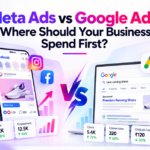
A clinic owner in Jalandhar sits down with ₹50,000 a month to spend on ads. (Swap in a coaching institute in Ludhiana or a jewellery brand in Amritsar, the story barely changes.) Their cousin swears by Instagram. Their last agency only ever talked about Google. A friend says both are a waste of money and WhatsApp forwards work better. So they ask the one sensible question: where do I put the first rupee?
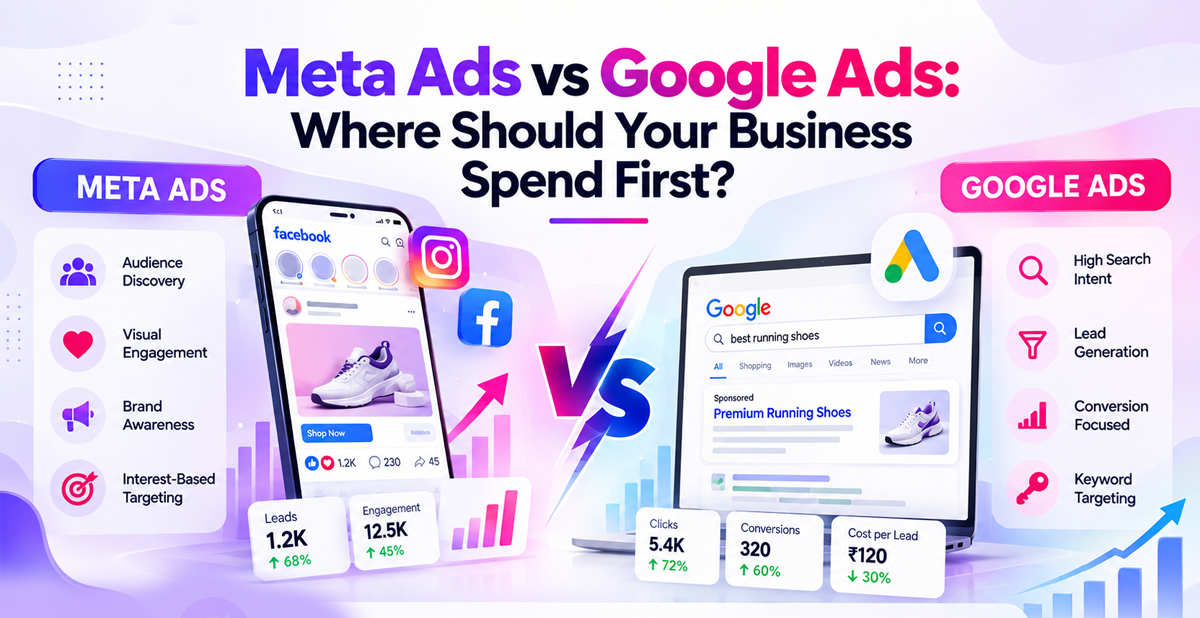
“It depends” is the usual answer, and it’s annoying mostly because it’s true. But it depends on something specific, and once you see it, the choice gets a lot easier. Google and Meta do different jobs. Marketing LTB’s 2026 attribution research found that Meta platforms influence about 41% of first-touch brand discovery, while paid search accounts for around 29% of last-touch conversions. Meta is where a lot of people first meet you. Google is where a good share of them decide.
So the real question isn’t which platform is better. It’s which job your business needs done first. This guide, written from a performance marketing agency’s point of view, walks through how to work that out, how to plan an ad budget without guessing, and where Punjab businesses tend to trip up.
Google is a raised hand. Meta is a tap on the shoulder.
When someone types “IELTS coaching in Ludhiana” into Google, they’ve already raised a hand. They want something, right now, and your ad gets to answer. On Meta, nobody asked. Someone is scrolling through reels between messages and your ad turns up. It might make them stop, or it might not, but you’re the one starting the conversation.
That difference shows up in the prices. WordStream and LocaliQ’s 2026 benchmarks put the average Google Ads click at about $5.42, with a cost per lead around $66.69 across industries. Meta clicks average closer to $0.78, although one 2026 benchmark roundup says Meta’s cost per thousand views rose roughly 20% in a year, to about $14. So it isn’t getting cheaper either.
Two warnings about those numbers. They’re mostly US dollar figures, and costs in India run well below them, so treat them as a shape, not a target. And cost per click is a bit of a trap anyway. A ₹10 click that never buys is more expensive than a ₹60 click that does. What matters is what each customer costs you, and that depends on what you sell and how people buy it.
When Google should get your first rupee
Start with Google when people are already looking for what you sell and the need is fairly urgent. Dentists, hospitals, plumbers, IELTS and study-abroad consultants, wedding venues, tractor parts, a manufacturer people find when they need a supplier. If your customers type your category into a search bar, you want to be the answer when they do.
It also suits local businesses well, since you can show ads only to people in Amritsar, or Mohali, or within a few kilometers of your clinic. And if you’re also working on your Google Business Profile, paid and organic results end up reinforcing each other.
The catch is that search has a ceiling. You can only buy as many clicks as people search for. If hardly anyone searches for what you sell, because it’s new, or unusual, or something people only buy after seeing it somewhere, you’ll spend a lot to reach a small crowd. And in crowded categories like admissions or legal services, the auction gets pricey fast.
When Meta should go first
Lean towards Meta when your product sells with the eyes. Fashion, jewellery, food, interiors, events, a new launch in Mohali, a restaurant that just opened. Or when nobody is searching for you yet, because they don’t know you exist. Search can’t help there. There’s no demand to capture, so you have to make some.
Meta’s real lever is creative. The platform rewards ads that make people stop: a good reel, a real face, a proper story. This is where an AI storytelling reel or a well-shot short film earns its keep, because on Meta the video does most of the targeting. Weak creative aimed at a clever audience usually loses to strong creative aimed at a broad one.
The catch is lead quality. Meta can bring in plenty of leads quickly, and a lot of them will be lukewarm: people who tapped a form while scrolling and barely remember doing it. Two things help. Ask one or two qualifying questions in the form, and call fast. Leads that get a call within the hour behave very differently from the ones that wait until tomorrow.
Planning your ad budget without guessing
Forget the platforms for a minute and do some arithmetic.
First, work out what a new customer is worth to you. Say a new patient is worth ₹12,000 over the first year. Next, how many leads turn into customers? If one in five does, a lead is worth about ₹2,400 to you (12,000 divided by 5). That’s the most you could pay per lead before you start losing money, and you’d want to pay a good deal less. Suddenly a ₹400 Meta lead and a ₹900 Google lead might both be fine, and the real question becomes which one actually turns into patients.
Second, give each test enough room. Most platforms need a few weeks of steady spending before the data means much, so judging a campaign after three days is like judging a cook by the raw dough. Plan on four to six weeks, and don’t starve a platform with a token ₹2,000 that never leaves the learning phase.
As a rough starting point, businesses selling local services or high-intent products often begin with most of the budget on Google, somewhere around two thirds to four fifths. Visual, consumer-led brands often start with 60 to 70 percent on Meta. One agency’s analysis of 84 campaigns landed in a similar place. Treat these as starting guesses to adjust when your own numbers come in, not rules.
And keep something back for retargeting, roughly a tenth to a fifth of the budget. Marketing LTB found that 52% of conversion journeys include at least one remarketing touch. Most people don’t buy the first time they see you, and the ones who come back are usually your cheapest customers.
It’s usually both, just not on day one
Pick the platform closest to the money first. If people already search for you, that’s Google. If you’re building demand from scratch, that’s Meta. Get one working, learn what a customer actually costs, then add the other.
Think of them as two halves of one journey. Someone watches your reel on Instagram on Tuesday. On Thursday they type your name into Google. If your listing or ad is there, great. If a competitor’s ad is sitting on top of your own name, you did the hard work and they collected. That’s why branded search and retargeting matter so much once Meta starts working.
Where Punjab businesses usually trip
Judging by views and likes. A reel with 200,000 views and no enquiries is a nice reel and nothing more.
Not tracking calls and WhatsApp clicks. For many businesses here, that’s where the real enquiries happen, and if you can’t see them, your ads look like they’re failing when they might not be.
Boosting posts from the app and calling it advertising. Boosting is fine for a quick push, but it skips most of the controls that make ads efficient.
Slow follow-up. A lead that waits two days is often a lead gone.
And festival season. Ad costs tend to climb when everyone is advertising at once, around Diwali and the wedding season for example, so plan for it instead of being surprised by the October bill.
Choosing a performance marketing agency in Punjab
If you’re shopping around, a few questions cut through most pitches.
Whose name is on the ad account? It should be yours. If the agency owns it, you can’t take your data with you when you leave. What exactly are they tracking: calls, WhatsApp clicks, form fills, actual sales? Will they report cost per lead or cost per customer? The first is easier to show, the second is what you care about. Who makes the creative, and does that team talk to the people running the ads? And what happens when something doesn’t work? Straight answers are a good sign.
Also be wary of guarantees. Nobody can promise a cost per lead before they’ve seen your market.
Industry Insights
Industry Shift. Ad platforms keep automating more of the buying, with Advantage+ on Meta and Performance Max on Google. The targeting tricks that once set agencies apart are mostly built in now, so the real work has moved to creative, tracking, and what happens after the click.
Why It Matters. When the machine handles targeting, everyone is driving the same engine. The edge comes from what you feed it: strong creative, clean conversion tracking, a clear offer, and quick follow-up. Businesses that treat ads as a system tend to pull ahead of the ones that treat it as a monthly budget.
What Smart Brands Are Doing. They start with one channel, prove the numbers, then expand. They measure customers, not clicks. And they run creative like a small studio, with a steady flow of new reels and stories instead of the same three ads for six months.
BubbleWorld Perspective. Paid media and brand aren’t opposites. Performance buys the attention, and brand decides whether that attention turns into trust. We like to plan the story and the spend together, because a great reel with no path to enquiry wastes money, and a perfectly tuned campaign with forgettable creative burns it faster.
Conclusion
If your ad spend feels like a guess, it doesn’t have to. BubbleWorld helps founders and marketing teams bring performance marketing, storytelling, and creative together so every rupee has a job and a number attached to it. Book a discovery call, bring your current ad numbers, and we’ll tell you straight where to spend first and what to fix before you spend more.
Frequently asked questions
Which is cheaper, Meta Ads or Google Ads?
Meta clicks are generally much cheaper than Google clicks, but a cheap click isn’t the same as a cheap customer. Search clicks tend to convert better because the person was already looking. The fair comparison is cost per customer, and that depends on your industry, your offer, and how quickly you follow up with leads.
How much should a small business in Punjab spend on ads?
There’s no single number. Start with the arithmetic: what a customer is worth, and how many leads turn into customers. Then pick a budget you can spend steadily for at least four to six weeks without panicking. It’s better to run one channel properly than two starved ones, and scale up once your cost per customer makes sense.
Can I run Meta and Google Ads at the same time?
Yes, and many businesses eventually should. The trick is the order. Get one channel producing measurable results first, then add the second to cover what the first misses. Meta often builds awareness and retargets, while Google captures people at the moment they search. Running both too early on a small budget usually just spreads you thin.