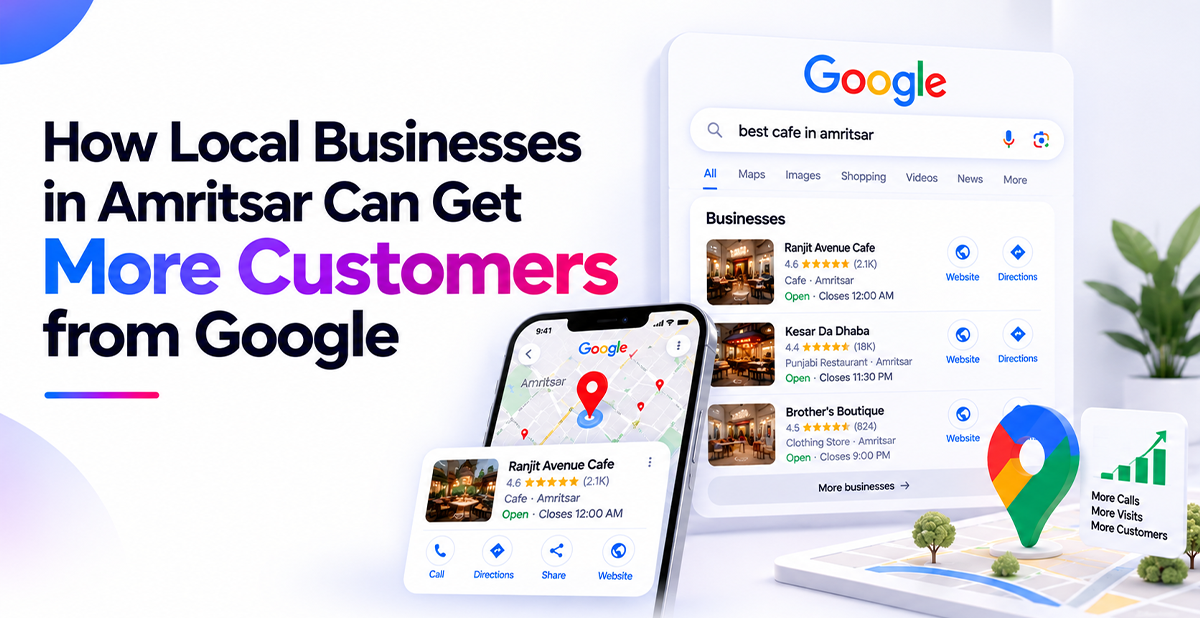
Picture it. Tuesday afternoon, somewhere near the Golden Temple. A family from Pune is hungry, a bit lost, and arguing about whether to ask a stranger or ask Google. Google wins. “Best kulcha near me.” Three places pop up on the map. They tap the one with loads of photos, opening hours that make sense, and a few hundred reviews, and off they go.
Meanwhile the place two lanes over, which honestly makes better kulcha, didn’t even make the list.
That’s local search, and it isn’t entirely fair. According to Google, about 46% of all searches have local intent, and Think with Google’s much-quoted number is that 76% of people who search “near me” on their phone visit somewhere within a day. Both are global figures, not Amritsar ones, but if you run a shop, clinic, or restaurant here you’ve probably watched it happen. People decide quickly, on a small screen, from whatever shows up first.
So local SEO in Amritsar boils down to a pretty simple question: when somebody nearby is ready to spend money, does Google put you in front of them? The rest of this post is about how to make that a yes. Most of it is free and a fair bit of it is dull, which is partly why your competitors haven’t done it.
First, what are we even talking about?
Local SEO is just SEO with a map attached. Normal SEO tries to get your website seen by anyone, anywhere. Local SEO cares about the person who’s close by, or who’s searching for something in your city. And where does that happen? Mostly in the little box of three businesses at the top of the results (the local pack) and on Google Maps.
Neither of which is your website, by the way. For most local businesses, the Google Business Profile does more of the selling than the homepage ever will. If your website is ancient, or you don’t have one, that’s oddly good news. If you’ve never actually opened your profile, it might be a small shock.
Your Google profile is the real front door
If you only do one thing after reading this, make it this one. Whitespark’s 2026 survey of local SEO experts put Google Business Profile signals at roughly 32% of what decides who shows up in the local pack, the biggest chunk of anything. The same survey named your main business category as the single most important factor on its own. One dropdown. Worth five minutes of your time.
So, claim it. Search your own business name. If there’s a profile you never made, it’s probably an old listing and you can claim it. If nothing’s there, create one. Verification can take a few days, so don’t leave it for the week before Diwali.
Pick your main category properly. “Restaurant” tells Google almost nothing. “Punjabi restaurant” tells it plenty. A dentist who mostly does implants should look at “Dental implants provider” alongside “Dentist.” You can add secondary categories for everything else.
Then the name. Use whatever’s on your signboard. I know the temptation to write “Sharma Clinic Best Dentist Amritsar Low Cost.” Don’t. Google can suspend profiles for it, and it makes you look a little desperate to the very people you’re trying to impress.
Go slowly over the boring stuff. Pin in the right spot, a phone number a human actually answers, correct hours. And festival hours, please. Baisakhi, Diwali, Gurpurab, whichever days you close early or stay open late. Turning up to a closed shutter because Google said you were open is how you lose a customer for good.
Photos next, and real ones. The front of the shop (people circle the area looking for it, so help them), the inside, the food or the team, where to park. Google’s own figures, widely quoted, say customers are about 2.7 times more likely to trust a business with a complete profile, and four blurry photos from 2019 don’t feel complete.
Write the description the way you’d explain your place to a new neighbor. Two or three sentences: what you do, who it’s for, roughly where, maybe Ranjit Avenue or Lawrence Road. After that, post something now and then. An offer, a festival menu, a new arrival. It doesn’t need to be daily. It does need to be less than a year old. And make yourself easy to reach: phone, website if you’ve got one, and for plenty of businesses here, a WhatsApp link.
Reviews: ask. That’s most of the secret.
BrightLocal’s research, as it’s usually reported, says around 87% of consumers use Google to judge local businesses. In real life that means they look at your stars before they look at almost anything else, sometimes before they’ve read what you sell.
Most owners know this and still don’t ask. Happy customers are usually glad to leave a review, they just don’t think of it. So give them a nudge. A WhatsApp message after the visit with your direct review link (your profile has a “get more reviews” link you can copy). A small QR code at the counter or printed on the bill. A staff member who asks right when someone says thanks.
Then reply. To all of them. Real thanks for the good ones, not the same copy-pasted line, and a calm, human answer to the bad ones, with an offer to sort things out. Future customers read your replies almost as closely as the reviews. If someone writes in Punjabi, answering in Punjabi goes a long way.
What not to do: buy reviews, or only ask the customers you already know are thrilled. Google doesn’t allow either, and people can smell a fake review from across the street.
What “near me” really means
People don’t love this bit. When someone searches “near me,” Google cares a lot about how close you are to them at that moment. You can’t fake that and you shouldn’t try. A shop on Majitha Road won’t beat one right next to someone standing in Hall Bazaar, however clever its SEO.
What you can do is be the obvious choice among the places that are close enough. That mostly means saying clearly what you do. If someone searches “dental implants near me” and your profile just says “Dentist,” you’re relying on luck. Fill in your services. Keep your hours current. Tick the small attributes like free parking, wheelchair access, or takeaway, because Google uses them as filters. And keep collecting recent reviews.
You’ll also get searches that never say “near me,” like “best pediatrician in Amritsar” or “wedding photographer Amritsar.” The same things help, but your website carries more weight there, which brings us to…
What your website is actually for
If you have one, its job is to back up what your profile says. Your address and phone number on the contact page and in the footer, written exactly as they appear on Google. One page per main service instead of a single page called “Services.” “Teeth whitening in Amritsar,” with real details, who it suits, photos, and the questions people always ask. Mention the areas you serve if it’s more than one. Put a call button and a WhatsApp button where thumbs can reach them, because most visitors are on phones, and test it on mobile data, not your office wifi.
And think about language. Plenty of people here search in a mix of Punjabi, Hindi, and English. You don’t need to translate everything, but use the words your customers actually use, and read your pages out loud. If it sounds like a brochure, rewrite it until it sounds like you.
Make your details match everywhere
Google double-checks you against the rest of the internet. If your profile says “Shop 14, Ranjit Avenue,” Justdial has a different phone number, and Facebook still lists the address from three years ago, Google trusts you a little less. Pick one way of writing your name, address, and number, and copy it everywhere: Google, Justdial, Sulekha, IndiaMART if you sell to other businesses, Facebook, Instagram, Apple Maps. Check them twice a year. Not exciting, still worth it.
Mistakes that come up a lot
The usual suspects. Stuffing keywords into the business name. Adding fake or virtual addresses to look like you have more branches (Google is better at spotting these than you’d think). Ignoring reviews, or worse, arguing with a bad one in public. Forgetting festival hours. And setting the profile up once, then never looking at it again. None of these are hard to fix. Most just never get noticed.
Conclusion
If your Google profile has been sitting untouched since the day you set it up, there’s probably money on the table. BubbleWorld helps Amritsar businesses and ambitious brands bring local search, storytelling, and lead generation together into one steady stream of customers. Book a discovery call, bring your toughest local-search question, and we’ll tell you straight where you stand and what’s worth fixing first.
FAQ
What is local SEO in Amritsar?
It’s making sure your business shows up when people in or around Amritsar search Google for what you offer. In practice that’s a complete Google Business Profile, regular reviews, matching listings across directories, and a website that clearly says what you do and where. The goal is to land in Maps and that little three-business box, because that’s where nearby customers are ready to act.
How much does local SEO cost?
The basics are free. Google Business Profile costs nothing and you can set it up yourself this week. Agency fees vary with how many locations you have, how crowded your category is, and how much content and review handling you want taken off your plate. Compare quotes by what’s actually included and how results get reported, and walk away from guaranteed rankings.
How long does it take to show up on Google Maps?
A few weeks to see movement is common after you fix a profile and start collecting reviews, especially in a quieter category. Busy ones, like popular restaurants or dentists in crowded areas, can take a few months. Rankings also shift depending on exactly where the searcher is standing, so expect some wobble instead of one fixed position.
Do I need a website for local SEO?
Not strictly. A well-built profile can bring calls and visits without one. But a simple site with your address, a page for each service, and a clear call or WhatsApp button helps Google understand you and helps customers trust you. If it’s one or the other, start with the profile and add the site when you can.
How do I rank for “near me” searches?
You can’t change how close you are to the person searching, but you can be the clearest and most trusted option nearby. Choose accurate categories, list your services, keep hours current, add real photos, and collect recent reviews. Consistent details across directories help too. Think shortlist rather than hack.
How many reviews do I need?
There’s no magic number. Steady, recent reviews matter more than a big pile from years ago, and a few detailed comments read as more trustworthy than a wall of one-word ones. Ask every happy customer, reply to every review, and compare yourself with the top few competitors in your area instead of some global benchmark.
Can I do this myself, or should I hire an agency?
A lot of owners can handle the basics: claiming the profile, adding photos, replying to reviews. An agency earns its keep when you have several locations, a competitive market, or simply no time to stay consistent. Either way, keep ownership of your Google profile so you never lose access to it.
Does it work if I don’t have a shop, like a home service business?
Yes. Google lets service-area businesses hide their address and list the areas they cover instead. You still need the right categories, a phone number that gets answered, reviews, and clear service pages. Only list areas you really serve, because overstating them tends to backfire.