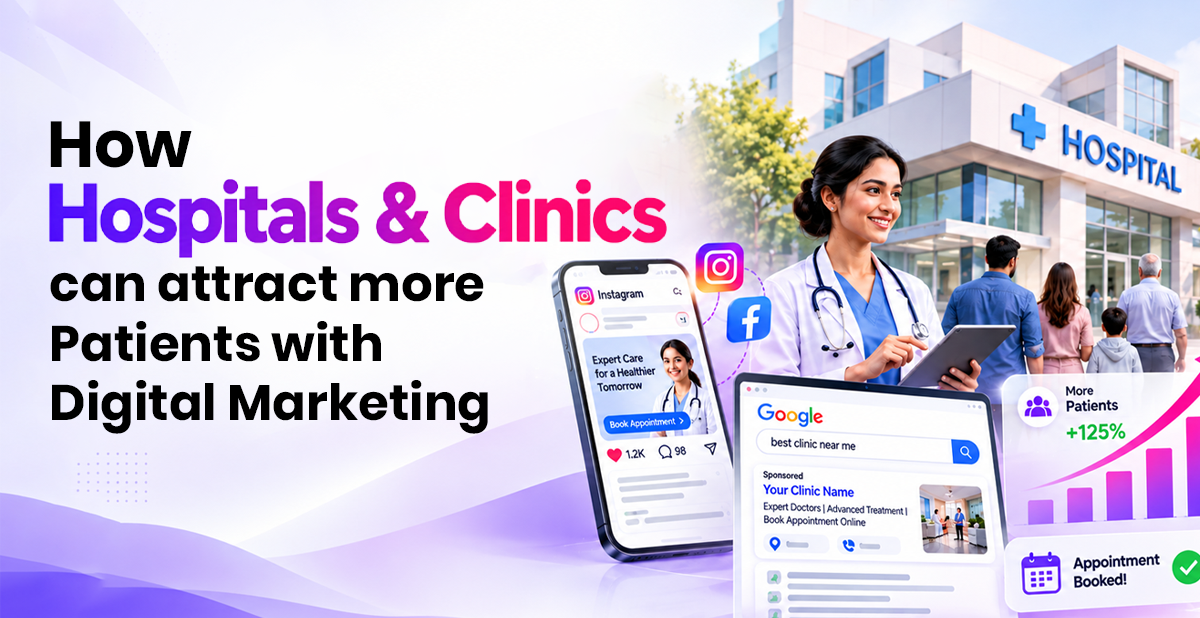
It’s 11 pm and someone’s dad has been getting chest tightness on the stairs. They’re sitting on the edge of the bed, phone in hand, typing symptoms into Google. Ten minutes later they’ve skimmed a couple of articles, opened two hospital websites, and sent a WhatsApp message to the one that actually said which doctor sees what, and when. That’s the hospital that gets the appointment. Not the one with the biggest hoarding on the highway.
Patients choose like this now. Searchlab’s 2026 healthcare analysis says about 82% research providers online before they book, and “doctor near me” searches have grown 185% since 2020. Plenty of Indian agency blogs claim 70 to 80% for the local number, though hardly any say where it comes from, so read it as a direction rather than a fact.
Now the bit most articles on this topic haven’t caught up with. On 6 October 2026, the National Medical Commission put out new guidelines on ethical advertising and public communication, effective immediately. Social media, influencers, sponsored content, and AI-generated material all fall under them. So the real question has changed. It’s no longer just “how do we get more patients online?” It’s “how do we do that without losing patients’ trust, or ending up on the wrong side of the rules?” That’s what we’ll work through here, from a healthcare marketing agency’s side of the table.
What patients do before they book
Nobody wakes up wanting a hospital. They wake up with a worry. It usually starts with a symptom, a question, or something a relative said, and then it moves through a few quiet stages before anyone picks up the phone.
They look for information first, and more and more of that now lands in the AI summary at the top of Google. BrightEdge data cited in 2026 industry research has AI Overviews showing up on roughly 88% of healthcare queries. Then they look for a place: a map result, a hospital website, a doctor’s page. Then they look for reassurance, which means reviews, credentials, how the place looks, whether the information sounds honest or salesy. Last, they look for the easiest way to book. If any step feels confusing or a bit off, they drift to the next option. They won’t tell you.
Which is why a patient acquisition strategy isn’t one big marketing job. It’s a chain, and the weakest link decides how many people ever reach your front desk.
First, the rules (because they just changed)
A quick disclaimer: we’re a marketing agency, not a law firm. This is a plain-language summary, not legal advice. Read the actual NMC notice and have someone who knows medical law look over your content.
Here’s the gist of what’s been reported about the 6 October guidelines. Facts and education are fine: what services you offer, what equipment and facilities you have, your accreditations, health awareness content, your doctors’ qualifications. Bragging isn’t. No claims of being better than others, no guaranteed outcomes, no comparisons, no fear-based messaging, nothing designed to make people want procedures or tests they don’t need.
Doctors and hospitals also can’t ask patients for testimonials or reviews to use in social media promotion, and can’t share manipulated ones. Patient photos, clinical images, and before-and-afters are restricted, and the guidelines are clear that a patient’s consent doesn’t automatically make a prohibited practice okay. AI-generated content can’t be used to mislead. Doctors posting online are expected to show their name, qualifications, and registration number. And if an agency or an influencer posts for you, the responsibility is still yours.
Two caveats. The guidelines are only days old, so some grey areas, like branded hospital awareness content, may get clarified later. And other rules haven’t gone anywhere: ASCI’s code, the Drugs and Magic Remedies Act, India’s data protection law. The easiest way to stay safe is to build a compliance check into how you work from day one, instead of panicking after something goes live.
Hospital digital marketing: what actually brings patients in
Start with a website that answers questions
Most hospital websites are built to impress the board. A worried daughter at 11 pm doesn’t care about the board. Give each specialty its own page, in plain language: what the condition is, who gets it, when to see a doctor, what happens during treatment. Keep doctor profiles factual (qualifications, registration number, specialty, consulting days). Put facilities, accreditations, location, parking, emergency numbers, and how to book where people can actually see them. Make it load fast on a phone, and make sure the call and WhatsApp buttons really work. Boring? Sure. It’s also where most people decide whether to trust you.
Get found on the map
A lot of patients just want somewhere nearby, and Google Maps is where that happens. Claim your Google Business Profile for the hospital and for the big departments. Correct hours, an emergency number, the right categories, and photos of the building, reception, equipment, and parking (never of patients). Write your name, address, and phone number the same way everywhere. Searches often go down to the neighborhood, so your pages should too.
Teach, don’t sell
This is where compliant marketing is at its best. Answer what people are actually typing: what causes this, when is it urgent, what happens in the test, how long is recovery. Have your doctors write it or review it, in plain English and in Hindi or Punjabi where your community expects it. Short reels and videos that explain things. It works twice over, because patients find you and because search engines and AI summaries prefer sources that are clear and credible. Just keep it educational. Once it starts bragging, it stops being education and becomes exactly what the guidelines are about.
Handle reputation with care
Everyone knows reviews matter, and the temptation is to go out and collect them aggressively. After the new guidelines, slow down. Doctors and hospitals can’t request testimonials or reviews for social media promotion, so how you ask for feedback needs a proper compliance check, not a guess. Some things are always safe. Give people an experience worth talking about. Never buy or fake reviews. Reply to feedback calmly, without confirming anything about a patient’s treatment. Something like “We’re sorry your experience fell short, please reach out to our patient relations team” says a lot and gives away nothing.
Use paid search, but keep it plain
Google Ads can work for things people actively look for, like health check packages, elective procedures, or a specialty clinic. Write the ad copy as facts, skip the superlatives, and send people to a useful page instead of a hard sell. Leave “best” and “guaranteed” out completely. They’ll get you in trouble with the guidelines and with the ad platforms.
Fix the part nobody puts in the deck
A shocking number of patients are lost after the click. The phone rings out. A WhatsApp message sits for six hours. The booking form wants eleven fields. The reminder never goes out. Before you spend another rupee on ads, fix the front desk. Reply quickly, make booking easy, send reminders (with proper consent, since patient data comes with legal duties), and check in after the visit. These habits cost almost nothing, and they change how people talk about you.
Doctor marketing, carefully
Doctors often want their own brand, and it makes sense, because patients search for people as much as buildings. But this is where the rules are tightest. As reported, doctors can take part in health awareness work, public health campaigns, and educational content, provided it doesn’t promote their own practice, solicit patients, or get monetised through promotional marketing. Product endorsements, influencer tie-ins, patient testimonials, and self-promotional photos are out.
So in practice it works best when the hospital carries the brand and the doctors contribute knowledge: a short explainer, a Q&A, a talk at a health camp, with their name, qualifications, and registration number shown. Let the quality of the explanation do the persuading.
How to tell if it’s working
Ignore likes and views. What you want to know is how many enquiries came in, how many became booked appointments, how many people actually showed up, and what each booked appointment cost. Ask one simple question at registration, “How did you hear about us?”, and add call tracking and WhatsApp click tracking for the rest. If you can’t tell which channel brought a patient in, you can’t decide where the next rupee goes.
What we’d stop doing today
Calling yourself the best or number one at anything. Promising results, or hinting at them. Before-and-after galleries borrowed from clinics abroad. Boosting a post with one doctor’s face and “book now” across it. Buying or faking reviews. Publishing AI-written health articles that nobody on the medical team has read. And assuming the agency carries the risk. It doesn’t. That stays with you.
Choosing a healthcare marketing agency in India
If you’re comparing agencies, a few questions cut through the pitch. Can they show you how they apply the NMC and ASCI rules to an actual piece of content? Who on the medical side signs off before it goes live? Whose name is on the ad accounts, the website, and the Google profile? (It should be yours.) What will they report: enquiries, booked appointments, show rate, cost per booked appointment? Do strategy, content, SEO, and ads sit together, or will you be refereeing between vendors? And will they say no when an idea is risky?
That last question tells you the most. An agency that never pushes back is either not reading the rules or not worried about your risk.
Industry Insights
Industry Shift. Healthcare marketing in India is moving from promotion to information. Patients want clarity, regulators want restraint, and search engines and AI answers reward sources that are accurate and easy to understand. All three pressures now point the same way.
Why It Matters. Hospitals that keep running the old playbook of superlatives, testimonials, and before-and-afters carry growing risk, and they’re building on formats patients trust less every year. Hospitals that become the clearest, most helpful source in their city build something that survives rule changes and algorithm changes alike.
What Smart Brands Are Doing. They put the compliance check inside the workflow, not at the end of it. They invest in plain-language education, a fast and kind front desk, and a website that works on a phone. And they count booked appointments instead of views.
BubbleWorld Perspective. Healthcare is the one category where trust is the product. We think the best healthcare marketing looks a lot like good communication: calm, clear, honest, well made. Storytelling still matters. A well-shot film about how your care process works, explainer reels that teach, a director talking about the hospital’s values. It just has to inform instead of boast, and that’s a creative challenge worth taking on.
How this plays out in practice
Scenario. A multispecialty hospital in a tier-2 city relies on word of mouth and hoardings. Its website is a brochure, the Google profile hasn’t been touched in a year, and WhatsApp enquiries get answered the next morning.
Strategy. Rebuild the website around patient questions, with a page per specialty and factual doctor profiles. Clean up the Google profiles for the hospital and key departments. Publish educational content written with the medical team and reviewed before it goes up. Run search ads on a few high-intent services with factual copy. Set a rule that every WhatsApp enquiry gets an answer within a fixed time, and track booked appointments by source.
Outcome. The realistic expectation is steadier enquiries, more of them turning into booked appointments, and much clearer data on what’s working. None of it is a growth hack and none of it shows up overnight, but it holds up when the rules and the algorithms change.
Conclusion
If you want more patients without putting your name, or your doctors’ registrations, at risk, let’s talk. BubbleWorld helps hospitals, clinics, and healthcare brands build marketing that’s clear, credible, and built with the rules in mind, with strategy, SEO, storytelling, and performance working together. Book a discovery call, tell us what’s slowing down patient enquiries, and we’ll tell you straight what to fix first.
Frequently asked questions
What does a healthcare marketing agency in India do? It helps hospitals, clinics, and doctors get found and trusted online: website and SEO, Google Business Profiles, health education content, paid search, reporting, and sometimes creative like explainer videos. A good one also works with your medical team on sign-off, since healthcare content has to be accurate and compliant, and helps you improve what happens after an enquiry arrives.
Can hospitals and doctors advertise in India? Factual and educational communication is generally fine. Soliciting patients, claims of superiority, guaranteed outcomes, and misleading content are not. The NMC’s 6 October 2026 guidelines extend this framework to social media, influencers, and AI-generated content, and they apply immediately. The details are still being interpreted, so get qualified legal advice before you launch campaigns.
Can doctors post on social media? As reported, educational content and health awareness activities are allowed, as long as they don’t promote the doctor’s own practice, solicit patients, or get monetised through promotional marketing. Doctors are expected to show their name, qualifications, and registration number. Self-promotion, product endorsements, and patient testimonials aren’t allowed. Check the full guidelines or take legal advice before posting.