In a world where attention has become the most expensive currency, being visible is no longer enough. Every day, consumers are bombarded with thousands of messages—on their phones, laptops, streets, and screens. Ads flash, notifications ping, stories autoplay. Most are noticed for a moment… and forgotten just as quickly. The real challenge for brands today isn’t being seen—it’s being remembered.
This growing sense of ad fatigue has pushed marketers to rethink a fundamental question: How do you create a connection that lasts beyond a scroll or a click?
The answer lies in experiential marketing—a powerful approach that moves beyond telling stories to letting people live them. Instead of passively consuming messages, audiences step into the brand’s world, engaging with it through emotion, interaction, and memory. When people experience a brand firsthand, it stops being a message and starts becoming a moment.
It’s no surprise then that 84% of brand marketers consider experiential marketing a critical strategy, and nearly 29% of brands actively use it, placing it among the top five marketing channels today. Because experiences don’t just attract attention—they spark emotions, inspire conversations, and build loyalty that traditional advertising struggles to achieve.
What Is Experiential Marketing?
Think of experiential marketing like this:
Instead of a brand telling you how cool it is through ads, it lets you experience it yourself.
Imagine seeing an ad for a new pair of sneakers versus actually trying them on, playing a game, attending an event, or being part of something fun created by that brand. Which one will you remember more? Exactly—that’s experiential marketing.
Experiential marketing is when brands create real-life or digital experiences that people can interact with. These experiences can be:
- Physical (events, pop-ups, activations)
- Digital (apps, games, personalized content)
- Or a mix of both
The main goal is simple: to make you feel something—excitement, happiness, curiosity, or even pride.
Unlike traditional ads that just focus on how many people see them, experiential marketing focuses on how people participate. When you’re part of the experience, the brand stops feeling like just a logo or an ad—and starts feeling like a memory you’ll talk about, share online, and remember later.
In short:
If advertising is about watching, experiential marketing is about living it.
Why “Felt” Brands Win Over “Seen” Brands
Modern consumers don’t just buy products; they buy experiences, values, and stories. A brand that people feel connected to emotionally is far more likely to be trusted, recommended, and remembered.
Experiential marketing works because it:
- Encourages real-world or interactive engagement
- Creates shareable moments that amplify reach organically
- Builds authentic emotional connections
- Drives stronger brand recall and loyalty
To understand its real impact, let’s look at some standout experiential marketing campaigns that prove why experiences matter more than visibility alone.
Use Cases: Experiential Marketing Done Right
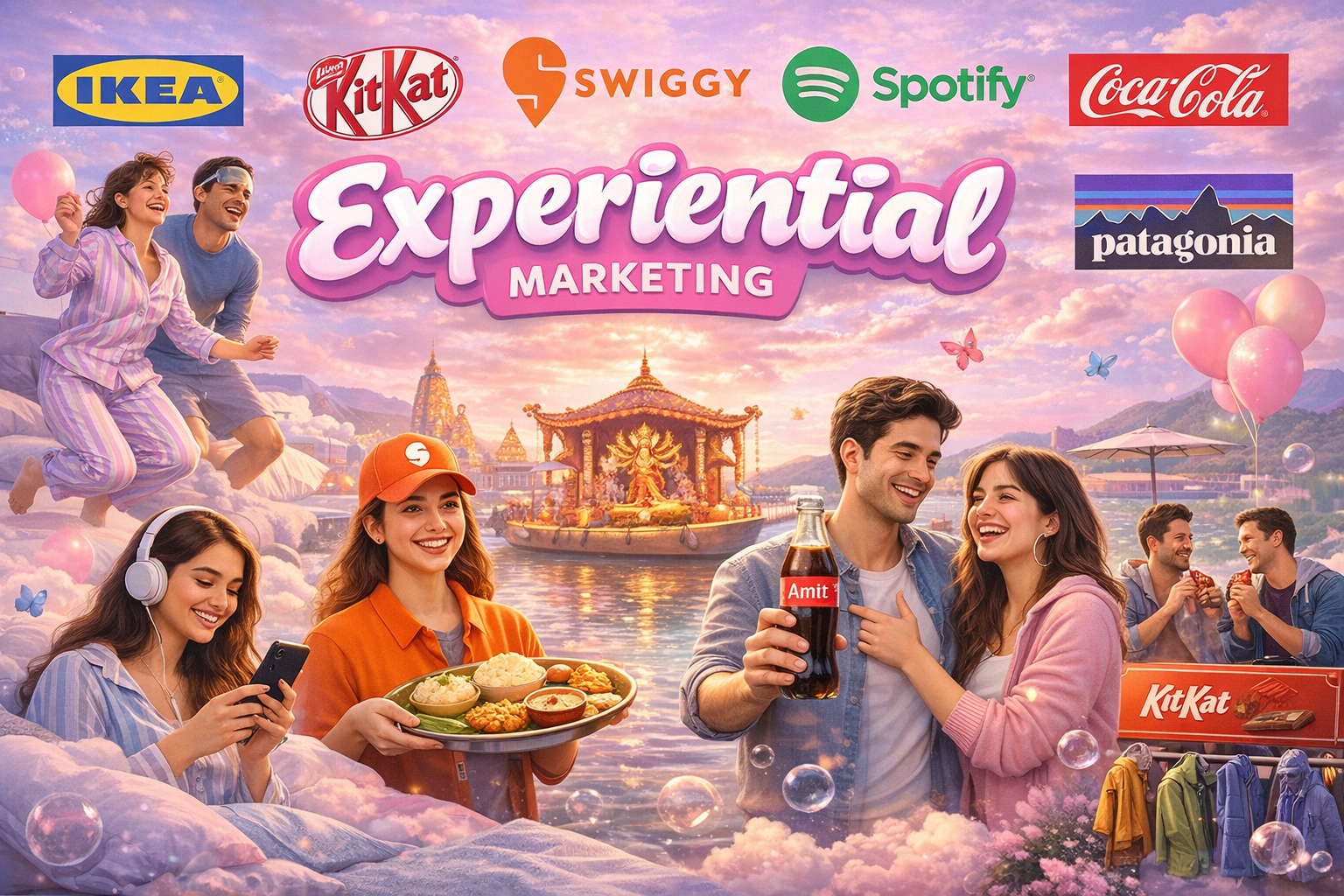
1. IKEA – The Legendary IKEA Sleepover Experience
IKEA is often cited as one of the most iconic examples of experiential marketing—and for good reason.
In 2011, a Facebook group titled “I Wanna Have a Sleepover at IKEA” unexpectedly gained over 10,000 members. While many brands would have dismissed this as a prank, IKEA saw an opportunity. The company turned a casual social media moment into a full-scale experiential campaign.
At its Lakeside store in Essex, UK, IKEA hosted a giant sleepover for 100 selected winners. The event included customized beds, pillows, blankets, spa treatments, treats, giveaways, and even a celebrity bedtime storyteller.
Participants didn’t just see IKEA furniture—they lived in it. They shared their experience on social media, bloggers and influencers amplified the story, and global media picked it up. The result was massive organic buzz and a powerful emotional connection with the brand.
This campaign proved that when customers experience comfort firsthand, trust follows naturally.
2. Swiggy – Floating Durga Puja Pandal (Bhog Elo Boney)
Swiggy’s floating Durga Puja pandal in the Sundarbans stands out as one of the most culturally rooted experiential campaigns in recent years.
Instead of focusing on urban celebrations, Swiggy took Durga Puja to remote riverine communities, delivering bhog via boats. This wasn’t just a brand activation—it was a thoughtful, purpose-driven experience.
The campaign was widely shared through Swiggy’s Instagram reels and posts, quickly becoming one of the most talked-about experiential marketing campaigns of 2025. It showcased Swiggy not just as a food delivery app, but as a brand that understands culture, inclusivity, and emotion.
By blending tradition, service, and storytelling, Swiggy created an experience people felt proud to associate with.
3. Coca-Cola India – Share a Coke
Coca-Cola’s “Share a Coke” campaign is one of the most iconic experiential marketing examples in India, proving that personalization at scale can create deeply emotional brand connections.
By replacing its logo with popular Indian names on Coca-Cola bottles, the brand turned an everyday product into a personal experience. Consumers were encouraged to find bottles with their own names or the names of friends and family, share them, and post their moments online.
What made this campaign experiential wasn’t just the packaging—it was the interaction. People actively searched for their names, gifted bottles, took photos, and shared stories across social media. The campaign generated massive user-generated content, supported by official visuals and videos, making it one of the most widely documented experiential marketing campaigns in the country.
4. Spotify – The Spotify Wrapped Experience
Spotify Wrapped is a masterclass in experiential marketing—entirely driven by personalization.
Every year, Spotify delivers a customized year-end summary featuring users’ top songs, artists, genres, and listening habits. What makes it experiential is not just the data, but how users emotionally connect with it.
The experience taps into nostalgia, identity, and self-expression, encouraging users to share their Wrapped summaries across social media. In doing so, Spotify turns millions of users into brand ambassadors—without traditional advertising.
This campaign proves that experiential marketing doesn’t always require physical events; digital experiences can be just as powerful when they feel personal.
5. Patagonia – The Worn Wear Tour
In a world constantly buzzing with notifications, KitKat stayed true to its iconic promise—“Have a break.” Instead of launching another digital-heavy campaign, the brand did something refreshingly opposite.
In Amsterdam, KitKat introduced Wi-Fi-free benches that blocked internet signals within a five-meter radius. The idea was simple yet powerful: when people sat on these benches, their phones stopped working. No notifications. No scrolling. Just a pause.
What happened next was exactly what the brand intended. Strangers started talking, friends became more present, and people actually enjoyed their KitKat without digital distractions. The experience didn’t force engagement—it invited it naturally.
This campaign became one of the most talked-about guerrilla marketing and experiential activations, proving that experiential marketing doesn’t need scale or complexity to succeed. Sometimes, the strongest brand experiences come from solving a modern problem in the most human way possible.
By encouraging people to disconnect digitally and reconnect emotionally, KitKat transformed a simple bench into a memorable brand moment—reinforcing that sometimes the best way to connect is to disconnect.
The Bigger Picture: Why Experiential Marketing Works
Across all these examples, one pattern is clear: experiential marketing succeeds because it creates moments worth remembering and sharing. These experiences blur the line between marketing and real life, making brands feel human, relevant, and authentic.
When customers feel something—joy, comfort, excitement, pride—they don’t just remember the brand. They talk about it.
Final Thoughts
In an age where attention is fleeting and ads are ignored, experiential marketing offers brands a way to stand out—not by being louder, but by being more meaningful.
Brands that are felt, not just seen, build deeper relationships, stronger loyalty, and lasting impact. Whether through immersive events, cultural storytelling, personalization, or purpose-driven experiences, experiential marketing transforms customers from spectators into participants.
And in today’s world, participation is the most powerful form of marketing there is.